A client recently asked us a fair question: if centralizers are standard practice for many deep anode groundbed installations, why doesn’t MATCOR use them with the Durammo™ Deep Anode Groundbed System?
The answer is simple: centralizers address a mechanical problem that Durammo solves by design.
The Durammo system’s slender profile, tensioned installation, and continuous MMO wire anode eliminate the conditions that make centralizers necessary in conventional deep anode designs.
Understanding the difference between Durammo and other deep anode systems explains why centralizers are essential for some cathodic protection systems—but unnecessary for others.
What Do Centralizers Do?
Centralizers keep rigid anodes positioned near the center of a borehole during installation. Their primary purposes are to:
- Promote even placement of coke breeze around the anode
- Prevent the anode from contacting conductive steel casing
- Reduce the risk of uneven current distribution
- Improve long-term anode performance and service life
These are legitimate concerns for many deep anode groundbed designs. They simply don’t apply to the Durammo Deep Anode Groundbed System.
Why the Durammo™ System Doesn’t Need Centralizers
A typical Durammo installation in an 8-inch borehole consists of:
- A continuous MMO wire anode approximately 0.125 inches in diameter
- An integral 1-inch vent pipe
- Two #8 AWG lead cables
- A lowering weight that keeps the assembly under constant axial tension
- Coke breeze backfill placed using bottom-up tremie methods
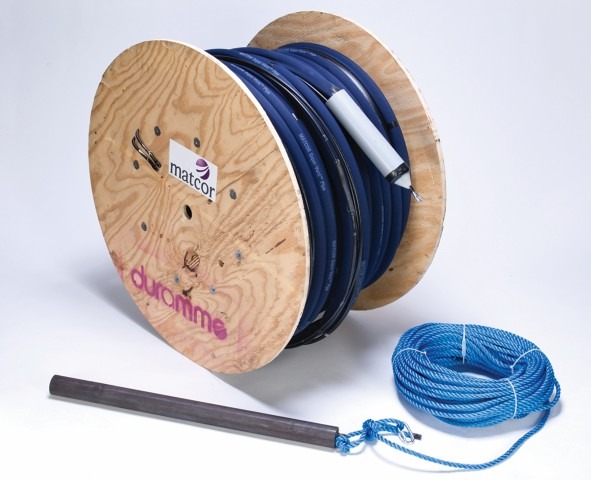
Together, the entire assembly occupies less than 15% of the borehole diameter, leaving more than six inches of clearance around the system.
This is fundamentally different from discrete anode systems, where large rigid bodies repeatedly interrupt the annular flow path and create opportunities for coke backfill bridging.
Plenty of Clearance Prevents Bridging
With more than six inches of open annular space, coke backfill has plenty of room to flow and settle uniformly around the assembly. There are no large rigid components to restrict flow or create bridging during installation.
Self-Centering Design Eliminates the Need for Spacers
The lowering weight keeps the wire anode, vent pipe, and lead cables under constant axial tension, allowing the assembly to hang like a plumb line. Rather than bowing or drifting toward the borehole wall, it naturally maintains its alignment without requiring mechanical spacers.
The integral vent pipe also adds stiffness to the assembly while promoting symmetrical gas evacuation during operation, helping preserve uniform coke breeze contact over time.
Coke Backfill Encapsulates the Assembly
The purpose of the coke backfill is to encapsulate and stabilize the assembly—not force it into a perfectly centered position. Once placed, the backfill locks the tensioned assembly in place, and minor offsets from dead center have little practical effect on performance.
Continuous MMO Wire Provides Uniform Current Distribution
Unlike discrete anodes that discharge from fixed locations, the continuous MMO wire anode distributes current along its entire length. This reduces localized current density and makes the system more tolerant of minor variations in backfill contact or assembly position.
No Steel Casing Contact Requiring Isolation
Many Durammo installations use PVC casing or uncased boreholes, meaning there is no conductive steel surface for the anode assembly to contact.
One of the primary reasons centralizers are used in other deep anode designs is to maintain separation between the anode assembly and conductive steel casing. In typical Durammo installations, that concern does not exist.
Controlled Installation Maintains Alignment
Bottom-up tremie placement of coke breeze allows controlled backfill placement while minimizing forces that could move the assembly. Combined with the tensioned design, this ensures the anode remains properly positioned throughout installation.
Why HSCI Anode Strings Still Need Centralizers
A string of discrete high-silicon cast iron (HSCI) anodes presents a very different set of installation challenges. Large rigid anodes, multiple lead wires, and localized current discharge create conditions where centralizers become an important part of the design.
Larger Anodes
A typical HSCI anode measures approximately 2.2 inches in diameter, occupying about 27.5% of an 8-inch borehole. With multiple rigid anodes suspended in the same borehole, each becomes an obstruction that restricts coke breeze flow and increases the likelihood of bridging.
Rigid Construction
Unlike a tensioned wire, rigid HSCI anodes cannot naturally remain centered. If one anode settles against the side of the borehole, neighboring anodes tend to follow, creating an eccentric string that cannot be corrected during backfilling.
Mechanical centralization is required to maintain consistent clearance and prevent uneven current distribution.
More Obstructions
Each HSCI anode requires its own lead wire. In a typical string, the combination of multiple anodes and multiple lead wires creates additional opportunities for cables to contact the borehole wall or interfere with uniform coke breeze placement.
Higher Current Density
Discrete HSCI anodes discharge current from fixed locations rather than continuously along their length. Uneven coke breeze placement or wall contact can therefore increase localized current density, raise resistance, and reduce anode service life.
Anode Interaction
Because multiple anodes are suspended with relatively close spacing, slight misalignment can reduce the gap between neighboring anodes. This can encourage coke breeze bridging or shielding between adjacent anodes, resulting in less uniform current output throughout the groundbed.
As a general engineering guideline, once discrete rigid anodes occupy roughly 25–30% of the borehole diameter, centralizers move from a conservative precaution to a practical necessity. A typical HSCI deep anode string exceeds that threshold.
Durammo™ vs. HSCI: Why One Needs Centralizers and the Other Doesn’t
The table below summarizes why these two anode geometries lead to opposite conclusions on centralizers.
| Feature | Durammo Deep Anode System | HSCI Anode String |
| Anode Type | Continuous MMO wire | Discrete cast iron anodes |
| Borehole Occupancy | Less than 15% | Approximately 27.5% per anode |
| Self-Centering | Yes | No |
| Coke Breeze Bridging Risk | Low | High |
| Current Distribution | Distributed | Localized |
| Centralizers Required | No | Yes |
Bottom Line for Deep Anode Groundbed Design
Centralizers are not a universal requirement for every deep anode groundbed installation. They’re designed to solve specific mechanical and electrical challenges associated with large, rigid anode assemblies.
The Durammo™ Deep Anode Groundbed System avoids those challenges through its slender profile, tensioned installation, and continuous MMO wire anode design. Traditional HSCI anode strings have the opposite characteristics, making centralizers an important part of a successful installation.
If you’re evaluating options for a deep anode groundbed installation, MATCOR’s corrosion engineers can help you select the right anode system for your borehole diameter, soil conditions, and current requirements.
[cta_content]