Category Archives: Cathodic Protection

Three Ton Sled Anode Assemblies Head to Beaumont, Texas

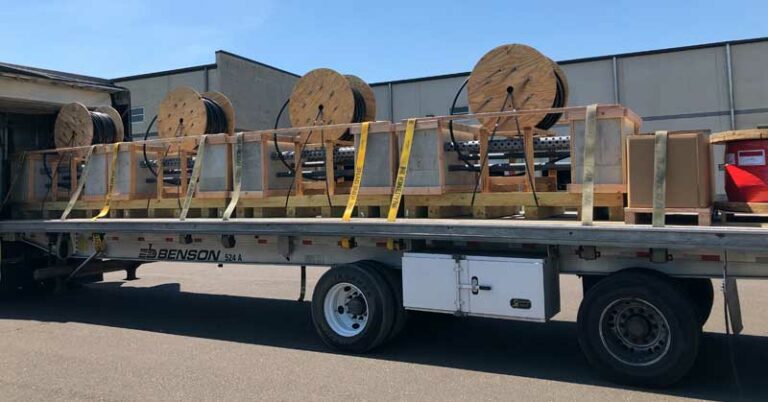
MATCOR shipped four of the heaviest customer sled anodes we have ever fabricated this month – over three tons each. Headed to Beaumont, TX, the anodes are part of a Gulf Coast refinery expansion project. The anodes will protect a variety of marine piling structures as part of a light crude processing expansion at the refinery.

Sled Anode assembly – pouring the concrete bases.

Each anode is rated for 75 amps and weighs approximately 6300 pounds. Each anode assembly consists of a pair of two-inch diameter Mixed Metal Oxide coated titanium tubular anodes, five-foot-long. The anodes utilize MATCOR’s proprietary tubular anode connection technology for larger diameter anode tubes. Each sled anode has two concrete bases resting on a common wood base fabricated with stout 6” x 6” pressure-treated wooden beams. The concrete ends include lifting lugs to support installation by crane either from land or on a work boat. The function of the treated wood beams is to sink into the sea floor.

Completed Sled Anode assembly – waiting on the concrete to cure.

The anode lead cables are dual insulated HMWPE/ Kynar 1/0 cables housed in a proprietary HDPE jacket and held in place along the sea floor using concrete weights.

Sled Anodes are an exceptionally cost-effective means of protecting large near-shore structures such as dolphins, jetties, pilings, and sheet pile walls. They are easy to install and even easy to remove in advance of dredging operations.

More Information About MATCOR’s Sled Anode Products

Marine Anode Sled Product Page

Houston Sled Anode Installation

[YouTube Video] MATCOR Sea-Bottom™ Marine Anode Sled

[Materials Performance Case Study] Impressed Current Anode Systems for Jetty Piling


Need information or a quote for MATCOR custom sled anodes? Please contact us at the link below.

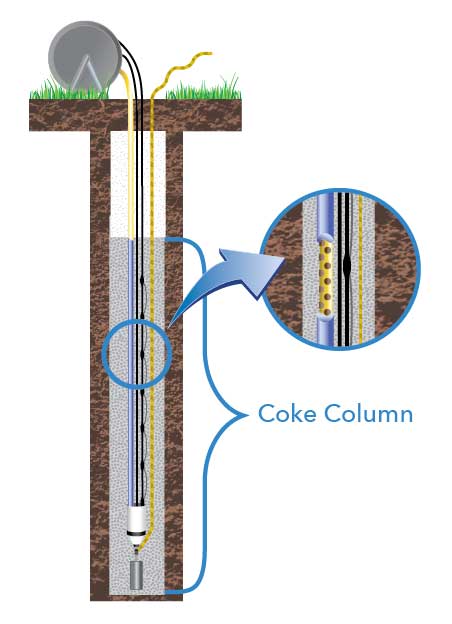
Coke Column Guidelines for Deep Anode Systems

OH NO, My Anode Bed is Not Performing!

This article explores a deep anode system gone wrong and guidelines for properly sizing the system coke column.


Earlier this year, we received a call from a pipeline customer with whom we have a solid relationship.

Historically, they used graphite anodes for their deep anode installations. But over the past few years, they began trying the MATCOR Durammo® Deep anode System with success.

When one of their new Durammo anode installations started having strange operating data, it was time to get MATCOR on the phone pronto and figure things out.

MATCOR reviewed the RMU operating data on the wayward installation and found that the data was indeed strange.

The DC output oscillated from periods of robust DC current output to periods of no discernible DC output. We also looked at the deep anode system design and noted the rather short coke column height. The height was only 100 ft of active anode in an 8-inch column. We sent a technician to the site to investigate.

First, we checked the installation and operation of the remote monitoring unit (RMU). Was a poor RMU connection causing intermittent good/bad data? This was not the case.

Next, we checked the continuity of the two anode lead cables. The Durammo® system has a top lead cable and a bottom lead cable. These two cables should be electrically continuous. In this installation, they checked out properly.

Finally, we checked the vent pipe for obvious issues.

Having confirmed that the spurious data was not the result of a poor RMU connection and that the anode system cabling appeared to be intact, we began to suspect that the problem was in the coke column and its immediate environment.

The Culprit? A Small Coke Column.

When we investigated further, we determined that the on-again, off-again readings could be the result of excessive gas generation into a rather small coke column. Both phenomena are heavily impacted by the anode system’s coke column to earth current density.

When the anode system generates more gas than can be exhausted through the vent pipe and diffused through the surrounding earth, gas molecules begin to accumulate between the column particles and at the anode to coke and coke column to earth interfaces. Gas is not electrically conductive, and with enough trapped gas in the column, the system resistance can quickly rise to a point that the anode system cannot overcome this resistance, and the current output drops quickly.

A short-term solution is to turn off the anode system for a period, allowing the gas to disperse inside the coke column and the system should return to normal operation. At least until the gas molecules build up again to block the anode system.

Coke Column to Earth Interface Current Density: The Magic Number

The magic number often cited for anode coke column to earth interface current density is 150mA/ft2. Anything above this number might cause problems. Below this number, history shows that the impact of gas blockage and drying out are generally minimal.

In our example, a 100 ft coke column with an 8-inch diameter hole means that any current output above 31 amps would be pushing that 150mA/f2 threshold.

The 150mA/ft2 current density assumes a high-quality, properly installed coke. This forms a well-compacted column that promotes electronic conduction and limits electrolytic conduction. A well-formed coke column is critical for anode systems using mixed metal oxide anodes, since MMO anodes have an inherently smaller surface area available to be in contact with the column.

It is unclear why the cp system designer recommended a short anode active length for this anode system – other than perhaps the cost saving of using less coke backfill.

While a shorter column does have a positive cost impact, the performance can become an issue, as was the case with this installation. Ultimately, this customer is planning a new Durammo® anode installation for this location with a significantly longer active area.


Need information or a quote for MATCOR deep anode systems? Please contact us at the link below.

MATCOR’s Ted Huck to Keynote at CORCON 2021

MATCOR’s Ted Huck, cathodic protection and AC mitigation expert, is pleased to be a keynote speaker at this year’s CORCON.

Ted Huck, MATCOR, Inc.

CORCON is Asia’s largest corrosion conference, hosted annually by the NACE International Gateway India Section (NIGIS).

The only larger corrosion conference is the NACE CORROSION Conference held annually in the Spring by NACE – we hope to see all of you in San Antonio Texas in 2022 where next year’s CORROSION Conference is scheduled.


Did you know? Our very own Ted Huck is “Youtube Famous” for his Cathodic Protection 101 video, with nearly a quarter-million views!


This year, the CORCON conference is virtual; however, the need for an opportunity to share information and experiences still exists. Even in the midst of a pandemic, show organizers are optimistic that they can resume a live conference in 2022.

MATCOR has over a decade-long history of involvement in the cathodic protection market in India. The company has participated in numerous CORCON conferences as speakers, session chairs, and as an exhibitor.

Corrosion Professionals in India

MATCOR has a small office and staff in Ahmedabad, India and we believe in the great work performed by the many corrosion professionals in India.

This year, we were pleasantly surprised when conference organizers reached out to Ted Huck, a frequent visitor and speaker at the NIGIS CORCON conference, to ask that he be a keynote speaker.

Corcon 2021 Keynote

On November 18, Mr. Huck delivered the presentation “AC Mitigation Criterion and the impact on Cathodic Protection Operations.”

The conference is scheduled for November 18-20, 2021.  For more information visit www.corcon.org.

In addition to speaking at the CORCON conference, you can also find MATCOR at the National Institute for Storage Tank Management conference in the Woodlands December 1st and 2nd.  Mr. Huck will be speaking in person at that conference on Tank Bottom Cathodic Protection Systems – Replacement Options.

Cathodic Protection Construction and Inflation

How Today’s Supply Chain Issues Affect Our Industry

For over a decade both the consumer and construction worlds have enjoyed very stable pricing with modest annual increases. 2021 is a very different picture. Suppliers are dealing with supply chain issues and price spikes. These increases far exceed the 2-3% we typically see for cathodic protection construction projects.

Cathodic Protection Construction

In today’s environment, manufacturers and service providers deal with this uncertainty by providing quotes with very limited duration. In some cases quotes are only valid for a few days. This is a far cry from the 30- to 90-day validity once common in the industry.

The challenge for everyone in the industry is the lag time between the budgeting phase of a project and the purchase of materials. For major projects, the planning, permitting and pre-construction phases of a project can take years.

It is important to note that the inflation figures we see quoted in the news are typically “consumer price index.” These inflation figures run about half of the less reported “producer price index,” which more accurately captures manufacturers’ material costs.

When you hear that the core inflation rate is 4 or 5%, you can reasonably expect that material costs are rising at 8-10%.

What can companies performing cathodic protection construction do to manage project budgets in an inflationary environment?

  • Take action quickly. Time is money. The longer you wait to purchase materials and services, the more you can expect to pay for them. Once you have approval for a cathodic protection project, order the key materials quickly.
  • Share the inflation risks fairly with your suppliers and contractors. Holding a contractor to yesterday’s prices is unrealistic and unsustainable. That contractor will be looking for ways to cut costs. And they may accomplish it by cutting quality, reducing the scope, substituting cheaper materials, or demanding change orders at every opportunity. This type of relationship does not benefit any of the parties.
  • Consider ordering materials separately from construction. This applies especially to materials you can pre-stage, have long storage life, or repurpose easily for other projects.
  • Be realistic when providing project schedules. Haven’t nailed down all the landowner or permit issues? Then don’t tell your suppliers and contractors that you expect the project to kick off next month.

What is MATCOR doing to address issues related to cathodic protection construction projects?

As a supplier of cathodic protection materials and construction services, MATCOR takes a team approach. We are eager to engage with customers and work together to minimize impacts from cathodic protection supply chain disruptions and price increases.

Stretch Your Cathodic Protection Budget

Now is a great time to think about stretching your 2021 budget and getting a jump start on 2022.

Days are growing shorter and long summer days are turning to dark winter days. This makes it difficult to spend the last of your CP budget dollars on completed construction projects this year.

Equipment and crews are generally already booked. However, MATCOR and our sister company JA Electronics can still help you spend your 2021 budget dollars productively.

We still have manufacturing capacity for this year. Purchasing cathodic protection anodes, rectifiers and other CP components now can help use up those remaining funds while also giving you a head start on 2022 projects.

Get Your Act Together

The first quarter is often a slower quarter in the construction business since companies are still planning their 2022 CP spend.

But what if you had your act together and were ready to start cathodic protection construction projects earlier in the year?

Well, we at MATCOR are eager to talk to you about special off-season pricing that we can offer for Q1 projects. Are you in a position to buy materials in Q4 and install them in Q1 of 2022? We can load share our construction capacity and provide off-peak pricing, making it very attractive indeed to have your act together.


Have questions or need a quote cathodic protection materials or construction services? Contact us at the link below. For immediate assistance, please call +1-215-348-2974.

Contact a Corrosion Expert

MATCOR Featured in Tanks and Terminals

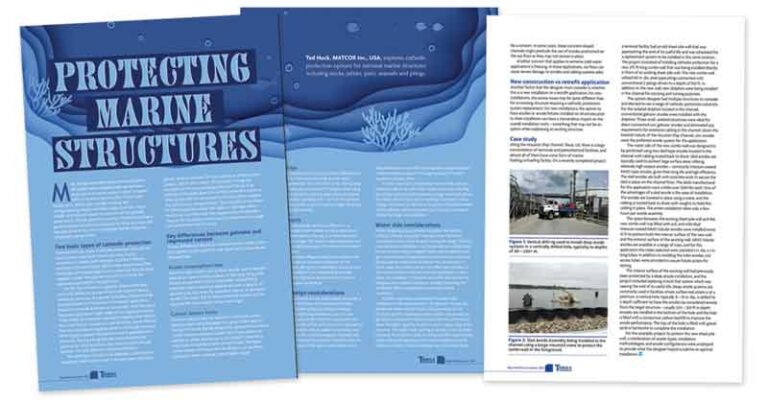
In the June 2021 issue of Tanks and Terminals, a quarterly supplement to Hydrocarbon Engineering, MATCOR’s Ted Huck discusses cathodic protection of terminal marine structures including docks, jetties, piers, seawalls and sheet pilings.

Protecting Marine Structures From Corrosion

The article includes a case story discussion from a Texas gulf coast facility using impressed current cathodic protection for a combi-wall structure (consisting of pipe piles and sheet walls.).

MATCOR provides industry leading cathodic protection and AC mitigation solutions to tank and terminal operators around the globe.

MATCOR’s New Offices Rock Customer Satisfaction

In 2019, MATCOR opened new offices in Casper WY, and Midland, TX to better support those regions.

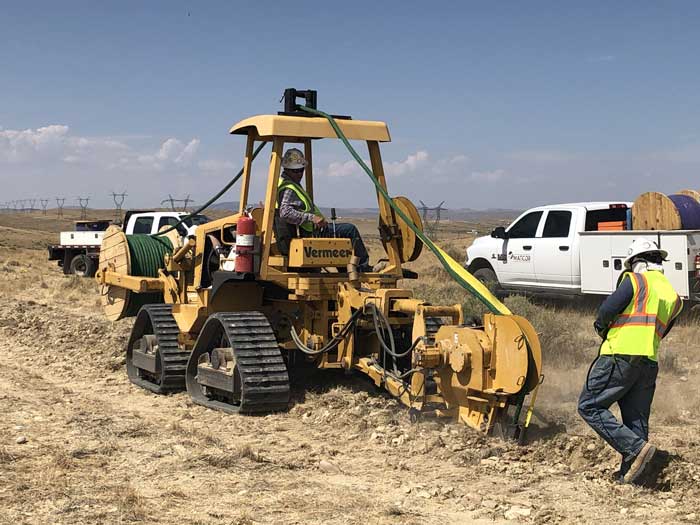
Two years and one pandemic later, we have seen great success from both regions as we’ve increased our service capacity, deployed construction crews and technicians and staffed each office with experienced cathodic protection professionals.

We recently highlighted a success story from our Casper Wyoming office detailing a successful AC Mitigation installation project.

This month we wanted to highlight a similar customer success story from our Horizontal Directional Drilling crew for two recent tank anode systems installed for a Texas based Midstream company with operations in the Permian.

Upon completion of the project, we received a compliment from the client’s Corrosion Supervisor, who reached out to MATCOR’s Permian based project manager, Mario Mahabir saying:

“Gentlemen, just wanted to extend our gratitude for the performance and professionalism we experienced from your team on the recent project at our facility.”

Well MATCOR appreciates the opportunity to work on this project!

For the this project, MATCOR designed, installed and commissioned dedicated under tank cathodic protection systems on two above ground storage tanks.

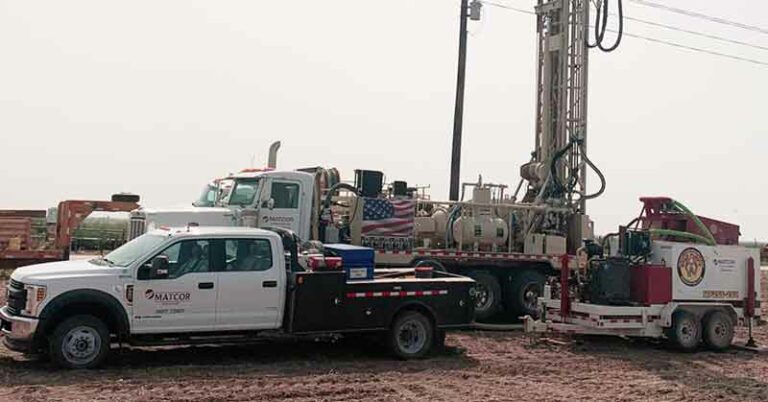
Installation was performed using our horizontal directional drilling rig and MATCOR’s proprietary mixed metal oxide anodes to install anodes and reference electrode pull tubes under two existing tanks.

Give the MATCOR Permian and Rockies teams a look—we think you will like what you see.


Have questions or need a quote for AC interference mitigation materials or services? Contact us at the link below. For immediate assistance, please call +1-215-348-2974.

Contact a Corrosion Expert

Navigating Cathodic Protection Supply Chain Issues

June 2022 Update

MATCOR has historically stocked and specified dual insulated HMWPE/Kynar™ for all of our chemically aggressive cable applications. Many other suppliers in our industry utilize HMWPE/Halar™ for their chemically aggressive cable applications. The two are generally seen as being equivalent materials for cathodic protection purposes.

Due to recent supply chain disruption, MATCOR has had to provide HMWPE/Halar™ in place of HMWPE/Kynar™. This is due to the availability of materials.

Unless explicitly instructed otherwise, MATCOR reserves the right to substitute these two cable installations interchangeably based on material availability.

Should you have any questions, please contact your MATCOR sales representative.

May 2021 Cathodic Protection Supply Chain Update

Historically, MATCOR has enjoyed an exceptional on-time delivery record. Over the past decade our lead times for anodes have gone down. 1-2 weeks for rush orders is quite achievable. 3-4 week deliveries are the norm for MATCOR manufactured cathodic protection products. Through 2020, we were able to navigate cathodic protection supply chain issues and avoid delays due to material availability.

However, if you are reading the news, you cannot help but see stories the stories:

The general state of the global economy is one of delay and disruption accompanied by price increases and surcharges.

In our cathodic protection manufacturing business, we have not been immune to these pressures. Supply is tighter and orders delayed for key items we use on a regular basis. This includes lumber for anode reels to Iridium for our mixed metal oxide anode coatings. Cathodic protection cable availability, especially for Kynar dual insulated cable, has gone from 4-6 weeks to 15+ weeks.

Shipping Issues

The cost and reliability of shipping channels is another challenge facing manufacturers. Both ocean freight and motor freight are struggling with shortages of containers, truck drivers, port congestion and rising fuel costs. Getting materials to our manufacturing facility and shipping them out is more difficult and less reliable than ever before.

At MATCOR, we have a great logistics team and a very flexible manufacturing team. Our on-time delivery record has suffered, but we are doing everything we can to minimize the impact on customers. We communicate early and often with those affected to advise them of any supply delays.

We encourage our customers to give themselves additional lead time by purchasing materials a little earlier than normal. This will assure that they have them on site well in advance of their planned installation. Engage early with MATCOR and your other suppliers to coordinate delivery timeframes. This is a good idea for both planned projects and critical timeline projects as we navigate these challenging times.

More about How Today’s Supply Chain Issues Affect Our Industry.


Don’t allow cathodic protection supply chain issues to affect your project. Plan ahead by contacting us at the link below. For immediate assistance, please call +1-215-348-2974.

Contact a Corrosion Expert

JA Electronics Q&A

RUSTY interviews JA Electronics VP Michael Grace

RUSTY Talks to Michael Grace, Vice President of JA Electronics

MATCOR is excited to welcome JA Electronics to the BrandSafway family, bringing decades of expertise and a range of cathodic protection rectifiers and other CP accessories to MATCOR customers.

We recently sat down with JA Electronics’ VP Michael Grace for this informative interview.

RUSTY: Michael, first off, welcome to the BrandSafway family – what do you think of your new logo?

MICHAEL: JA Electronics has a long and proud history of servicing the Cathodic Protection industry dating back to 1980. BrandSafway’s acquisition of the company marks a new and exciting chapter in that history.

The new logo is a great way to reflect on our past and look forward to our future as part of BrandSafway’s growing set of Corrosion and Integrity businesses. We are very excited about the opportunities ahead of us.

RUSTY: Other than a new logo, what big changes do you see coming for JA Electronics?

MICHAEL: Let’s start by saying what is not going to change—we are going to continue to supply the highest quality rectifiers on the market and do so at very competitive rates. JA Electronics has earned its reputation of providing rectifiers that are built to perform for the long haul. We are not changing our manufacturing team—our rectifiers are proudly built in Stafford, Texas by a team of experienced and dedicated rectifier assembly professionals. Another thing that will not change is our customer service. We stand behind our products and provide world class technical support.

What will change is our relationship with MATCOR. As a fellow BrandSafway company, MATCOR and JA Electronics will be actively looking at ways to partner our products and services. MATCOR, like JA Electronics, is an established name in the cathodic protection industry with a reputation for outstanding products and a long history of innovation. We expect to see collaboration with MATCOR on marketing efforts, shared R&D initiatives, and a closer pairing of our offerings to our customers to add greater value.

RUSTY: What makes JA Electronics a great value proposition?

MICHAEL: JA Electronics’ rectifiers are highly respected in the marketplace for their quality and reliability, a reputation that we have earned over the past 40 years.

Our conservative design basis sets us apart from other rectifier manufacturers. Our transformers, bridge stacks and wiring assemblies are all designed with a 20% safety factor. There are other features and material selection choices that we make to further enhance the reliability of our rectifiers. These design choices result in a higher quality product and allow us to offer a 2 year standard warranty, when most of our competitors limit their warranty to 1 year.

RUSTY: Are JA Rectifiers priced at a premium relative to other rectifiers in the market?

MICHAEL: There is a perception with some in our industry that JA Rectifiers are higher-end rectifiers and cost more than other brands. But the reality is that our rectifiers are cost-competitive with other suppliers even with the great value that we offer. Give JA Electronics a shot—we think you will be surprised at our competitiveness with other rectifier suppliers.

RUSTY: Why are aluminum enclosures better for cathodic protection rectifiers? What’s wrong with galvanized steel?

MICHAEL: Well, there is nothing wrong with galvanized steel enclosures. They’re just not as good as the aluminum enclosures that JA Electronics supplies. We prefer aluminum for its lightweight, anti-corrosive and thermal conductivity properties; whereas galvanized steel is significantly heavier, typically more expensive and does not provide the same level of corrosion resistance in outdoor installations that aluminum offers. The weight savings translates into reduced shipping costs and easier handling during installation. The aluminum enclosures we provide will never rust as aluminum will naturally react with the environment to create a thin oxidizing layer that protects the enclosure. We consider aluminum to be the superior enclosure material.

RUSTY: Is there anything we did not cover that the MATCOR customers might find useful to know about JA Electronics?

MICHAEL: We have a QuickTurn program that covers some of our most common sizes of rectifiers, and we will be looking to expand on this program working with MATCOR to better serve our customers’ needs.

Successful Sled Anode Installation Provides Houston Ship Terminal Corrosion Protection

This article describes a recently completed sled anode installation for ship terminal corrosion prevention on the water side of a dock structure along the Houston Ship Channel.

The project involved protecting a new combi pile wall being installed in front of an older existing conventional sheet pile wall nearing the end of its useful life. The combi wall utilizes large diameter steel pilings as the primary structure combined with conventional Z-pilings as the secondary structure.

Sled Anode ready to ship from MATCOR’s Chalfont, PA manufacturing facility

Project Details

For this project, there were twenty-seven 60” diameter steel pilings being driven to a depth of 100 ft and spaced approximately 10 feet apart.

This cathodic protection system design, prepared by another CP company, called for twenty-five discreet shallow vertical anodes to protect the land side area between the new and old dock structure and two sled anodes to protect the new water side.

The interior side of the existing wall was already being cathodically protected with a deep anode system.

MATCOR was successful in securing the contract for the supply and installation of the new sled anode system. We utilized MATCOR’s Sled Anode assembly consisting of mixed metal oxide coated, titanium tubular anodes installed with custom fabricated concrete ends. In addition, we utilized a Kynar/HMWPE #1 cabling system installed in a flexible protective black HDPE pipe.

Another Sled Anode Project for Jetty Piling Corrosion Prevention »

Benefits of MATCOR’s Sled Anodes for Ship Terminal Corrosion Prevention

Each of the sled anodes include lifting lugs for ease of installation and floating locator buoys to allow for temporary removal in the event of dredging operations.

The sled anodes weighed approximately 5800 lbs each to assure that the sleds remained anchored in place along the ship channel floor.

MATCOR sled anode installation for ship terminal corrosion prevention along the Houston ship channel
Installation of sled anode for ship terminal cathodic protection using a barge mounted crane

The use of sled anodes makes for an easy installation and minimizes the need for divers – in this case the use of divers was only needed to help route the cabling back to shore.

Each sled anode was designed for 75 amps output for 30 years continuous service in seawater. The two sled anodes are being powered off a common rectifier configured with an RMU for remote monitoring of the systems operations.

These sleds were installed using a qualified marine sub-contractor who provided a properly sized crane mounted on a barge to facilitate the installation.


Have questions or need a quote for ship terminal or other near shore structure corrosion prevention? Contact us at the link below. For immediate assistance, please call +1-215-348-2974.

Contact a Corrosion Expert

Get News from MATCOR

Sign Up for Our Newsletter

  • This field is for validation purposes and should be left unchanged.
    I understand my information will be stored securely for the sole purpose of conducting business with MATCOR, Inc. I agree to receive future email communication and understand that I may opt out at any time. View our Privacy Policy.