

All posts by MATCOR

Three Ton Sled Anode Assemblies Head to Beaumont, Texas

MATCOR shipped four of the heaviest customer sled anodes we have ever fabricated this month – over three tons each. Headed to Beaumont, TX, the anodes are part of a Gulf Coast refinery expansion project. The anodes will protect a variety of marine piling structures as part of a light crude processing expansion at the refinery.

Sled Anode assembly – pouring the concrete bases.

Each anode is rated for 75 amps and weighs approximately 6300 pounds. Each anode assembly consists of a pair of two-inch diameter Mixed Metal Oxide coated titanium tubular anodes, five-foot-long. The anodes utilize MATCOR’s proprietary tubular anode connection technology for larger diameter anode tubes. Each sled anode has two concrete bases resting on a common wood base fabricated with stout 6” x 6” pressure-treated wooden beams. The concrete ends include lifting lugs to support installation by crane either from land or on a work boat. The function of the treated wood beams is to sink into the sea floor.

Completed Sled Anode assembly – waiting on the concrete to cure.

The anode lead cables are dual insulated HMWPE/ Kynar 1/0 cables housed in a proprietary HDPE jacket and held in place along the sea floor using concrete weights.

Sled Anodes are an exceptionally cost-effective means of protecting large near-shore structures such as dolphins, jetties, pilings, and sheet pile walls. They are easy to install and even easy to remove in advance of dredging operations.

More Information About MATCOR’s Sled Anode Products

Marine Anode Sled Product Page

Houston Sled Anode Installation

[YouTube Video] MATCOR Sea-Bottom™ Marine Anode Sled

[Materials Performance Case Study] Impressed Current Anode Systems for Jetty Piling


Need information or a quote for MATCOR custom sled anodes? Please contact us at the link below.

Coke Column Guidelines for Deep Anode Systems

OH NO, My Anode Bed is Not Performing!

This article explores a deep anode system gone wrong and guidelines for properly sizing the system coke column.


Earlier this year, we received a call from a pipeline customer with whom we have a solid relationship.

Historically, they used graphite anodes for their deep anode installations. But over the past few years, they began trying the MATCOR Durammo® Deep anode System with success.

When one of their new Durammo anode installations started having strange operating data, it was time to get MATCOR on the phone pronto and figure things out.

MATCOR reviewed the RMU operating data on the wayward installation and found that the data was indeed strange.

The DC output oscillated from periods of robust DC current output to periods of no discernible DC output. We also looked at the deep anode system design and noted the rather short coke column height. The height was only 100 ft of active anode in an 8-inch column. We sent a technician to the site to investigate.

First, we checked the installation and operation of the remote monitoring unit (RMU). Was a poor RMU connection causing intermittent good/bad data? This was not the case.

Next, we checked the continuity of the two anode lead cables. The Durammo® system has a top lead cable and a bottom lead cable. These two cables should be electrically continuous. In this installation, they checked out properly.

Finally, we checked the vent pipe for obvious issues.

Having confirmed that the spurious data was not the result of a poor RMU connection and that the anode system cabling appeared to be intact, we began to suspect that the problem was in the coke column and its immediate environment.

The Culprit? A Small Coke Column.

When we investigated further, we determined that the on-again, off-again readings could be the result of excessive gas generation into a rather small coke column. Both phenomena are heavily impacted by the anode system’s coke column to earth current density.

When the anode system generates more gas than can be exhausted through the vent pipe and diffused through the surrounding earth, gas molecules begin to accumulate between the column particles and at the anode to coke and coke column to earth interfaces. Gas is not electrically conductive, and with enough trapped gas in the column, the system resistance can quickly rise to a point that the anode system cannot overcome this resistance, and the current output drops quickly.

A short-term solution is to turn off the anode system for a period, allowing the gas to disperse inside the coke column and the system should return to normal operation. At least until the gas molecules build up again to block the anode system.

Coke Column to Earth Interface Current Density: The Magic Number

The magic number often cited for anode coke column to earth interface current density is 150mA/ft2. Anything above this number might cause problems. Below this number, history shows that the impact of gas blockage and drying out are generally minimal.

In our example, a 100 ft coke column with an 8-inch diameter hole means that any current output above 31 amps would be pushing that 150mA/f2 threshold.

The 150mA/ft2 current density assumes a high-quality, properly installed coke. This forms a well-compacted column that promotes electronic conduction and limits electrolytic conduction. A well-formed coke column is critical for anode systems using mixed metal oxide anodes, since MMO anodes have an inherently smaller surface area available to be in contact with the column.

It is unclear why the cp system designer recommended a short anode active length for this anode system – other than perhaps the cost saving of using less coke backfill.

While a shorter column does have a positive cost impact, the performance can become an issue, as was the case with this installation. Ultimately, this customer is planning a new Durammo® anode installation for this location with a significantly longer active area.


Need information or a quote for MATCOR deep anode systems? Please contact us at the link below.

MATCOR Successfully Completes Tank CP Project In Mexico

JA Electronics explosion-proof rectifiers for tank CP project in Mexico.

MATCOR recently completed a significant tank CP project in the Mexican port city of Altamira along the Gulf of Mexico. The project consisted of design, detailed engineering, supplying materials, providing installation supervision, and commissioning and testing the systems upon completion of the installation for nine above-ground storage tanks.

Tank CP Project Utilizes Linear Anodes

The cathodic protection system utilized MATCOR’s SPL Linear Anode Concentric Ring tank system that consists of individual, factory assembled, and tested anode segments. This approach facilitates a simple installation that does not require cutting, splicing, or joining anode assemblies in the field. The anode rings utilize a redundant anode cable feed system that assures reliability. This cost-effective solution protects the bottom of tanks on projects across the United States and around the globe.

Explosion Proof Rectifiers

MATCOR also supplied customized explosion-proof oil-cooled rectifiers (pictured above) for each of these tanks from our sister company, JA Electronics. These rectifiers are used in Class 1 Div 2 hazardous areas. Additionally, cast aluminum Class 1 Div 2 junction boxes were also manufactured and supplied by JA Electronics.


Click below to get a quote for your tank CP project, or learn more about MATCOR’s cathodic protection solutions.

Training the Next Generation of Corrosion Technicians

MATCOR hiring corrosion technicians; entry level cathodic protection jobs.

Entry Level Cathodic Protection Technician Opportunities

The Cathodic Protection industry is a great niche that offers entry-level opportunities with tremendous long-term advancement potential. Unfortunately, we do not have enough Cathodic Protection technicians for the short, medium, and long term.

It’s not a sexy industry, but it has great-paying jobs located in the US. Once you are trained and have a few good years of experience, entry level cathodic protection jobs enable you to pick where you want to live, enjoy tremendous job security, and gain new opportunities.

A growing regulatory environment, aging pipelines that require more frequent monitoring and servicing, aging of the existing CP technician workforce, and decades of failing to attract new people in sufficient numbers has led to a significant shortage of CP technicians.

The Great Resignation

You have probably heard about the Great Resignation, an ongoing economic trend in which employees are resigning from their jobs. According to a recent Times article, Ryan Roslansky, the current CEO of LinkedIn, defined this differently as the Great Reshuffle. We have seen a 54% increase in the number of people changing their job descriptions. For Gen Z, that increase is 80%.

The bottom line is that workers, especially younger generations, are quick to change jobs as they attempt to find their interests in the world. These changes are occurring in the high-paying technical and industrial jobs as well.

Looking for a Great Opportunity?

So, if you are looking for your next job and hoping to find something that can lead to a meaningful career, look no further. MATCOR is always looking for eager young men and women who have an aptitude for hands-on mechanical work and sound math and science skills to fill entry level cathodic protection jobs.

Travel and Training!

Early in your career, you can expect regular travel as you gain more experience – about 75% of the time. We will also provide the requisite training. Many of our technicians advanced within MATCOR or took an opportunity elsewhere to work for pipeline companies as area technicians where the travel requirements are significantly less.


If you are interested in a challenging, rewarding career in an industry where the opportunities are endless, please contact MATCOR. We are hiring! Learn more about MATCOR careers or click below to apply for open positions.

MATCOR Receives Colonial Pipeline Circle of Excellence Recognition

matcor field safe lg e1613665272197

MATCOR was recognized recently by Colonial Pipeline as a recipient of their prestigious “Circle of Excellence” designation. Colonial’s contractor recognition program seeks to recognize contractors doing their part to support Colonial’s safety culture in their own organization. To be honored in the “Circle of Excellence” contractors must achieve:

  • Zero OSHA Recordables (Colonial)
  • Zero Fatalities
  • Zero OSHA citations
  • Zero Line/Equipment Strikes (Colonial)
  • Zero Product/Non-Product Spills (Colonial)
  • Contractor Performance Evaluation score of 90 percent or higher (Colonial)
  • TRIR less than or equal to Industry Average
  • RAVS Written Program Score of 100 percent (Colonial)
  • ISN Dashboard Grade of “A” (Colonial)

We are pleased to receive this recognition. MATCOR has a world-class observation-based safety program focused on an “I own Safety” approach.


Learn more about MATCOR’s safety program at the link below.

SuperVent™ Gets an Unexpected Upgrade

MATCOR just experienced our own “Wally Pipp” moment.

Even though it happened 97 years ago, sports fans today still remember the story of New York Yankees’ first baseman Wally Pipp. As the story goes, Wally told his manager that he had a headache and did not feel like playing that day for the Yankees. Sitting on the bench was a young man who was surprised to get the call to take the place of Wally Pipp in the lineup. That young man was Lou Gehrig and he played every game for the Yankees for the next 14 years, setting a consecutive games streak that earned him the nickname Iron Horse. Coaches continue to tell that story to their players to motivate them to play ball – you never know who might be waiting for the opportunity to take your place.

Our Wally Pipp Moment

MATCOR’s SuperVent™ deep anode venting pipe was introduced over 20 years ago. Since then, MATCOR had adapted the same inorganic, acid-resistant polyester fabric used on our Linear Anode product for the SuperVent product.

Procured from a local mill, the fabric is slit and sewn to our specifications. Supply chain issues, however, resulted in a temporary availability issue. Our long-time supplier informed us that the product we needed would not be available for 6-8 months.

The Search For An Alternative Vent Pipe Fabric

MATCOR’s SuperVent™ product is a key component of our world-class Durammo® deep anode system, and this type of disruption would have a significant impact on our customers.

We immediately began looking for an alternate supplier that could meet our requirements and provide more reliable delivery. And just as the Yankees were unexpectedly surprised to find a superstar to replace poor old Wally Pipp, MATCOR was surprised to find an alternate fabric material that was more readily available and similar in price.

Enter Lou Gehrig… this was a noticeably better product!

Our existing fabric worked fine, but it was intentionally a slightly larger diameter and had a noticeably loose fit. The old fabric was rip, tear and puncture resistant, however the loose fit, on rare occasions, could cause some issues while the deep anode system was lowered down the hole.

Old (top) and New (bottom) SuperVent Deep Anode System Fabric

The New SuperVent Material

The new fabric maintains the same chemical resistance and has similar rip, tear and puncture resistance.

The big difference is in the spandex material that gives the new fabric some stretch. When installed on our flexible HDPE pipe, the spandex fibers pull the polyester fabric filter cloth tightly to the deep anode vent pipe.

We are excited about this new fabric and feel that it is an incremental upgrade to what was already an industry-leading product. All the result of an unexpected supply chain issue!


For a quote or more information about MATCOR deep anode systems and SuperVent, please contact us at the link below, or reach out to your local MATCOR account manager.

Contact a Corrosion Expert

Stretching your Deep Anode System Budget

This article examines two cases where MATCOR customers were able to save up to 23% on their deep anode system budget.

cathodic protection budget, deep anode system budget

Today’s inflationary and supply-chain-impacted environment adversely affects many of our clients as they try to complete necessary upgrades and replacements to critical cathodic protection systems after two years of COVID-impacted operations.

Unfortunately, costs are climbing faster than most cathodic protection budgets. This often means doing less and/or pushing already overdue projects that should be completed this year into future budget cycles.

Relief For Your Cathodic Protection Budget

With owners stressed by diminishing return on limited cathodic protection budgets, there has never been a better time to consider MATCOR’s Durammo® Deep Anode System. Simply put, Durammo significantly reduces your installation cost compared to traditional deep anode systems.

If you are not familiar with MATCOR’s Durammo Deep Anode System or deep anode systems in general, read the articles below.

This article is not about the higher quality, longer system life, improved venting, greater ease of installation, lighter system weight, or the safer-to-install features of the Durammo – we have all of that going for us.

This article is about stretching your deep anode system budget. Let’s look at two recent quotes submitted by MATCOR in competitive bidding situations this month, March 2022. These are not abstract numbers for illustrative purposes, but real system quotes provided by MATCOR in a competitive situation.


CASE 1: High Silicon Cast Iron (HSCI) vs Durammo Deep Anode System in OKLAHOMA

This proposal was for a single anode system installation where there was an existing anode junction box and rectifier. The existing anode junction box reduces the materials savings since one is not needed for the Durammo. In this case, it is not needed for the conventional HSCI system either.

For most projects, the installation cost savings are higher when multiple anode systems are installed. While saving a few hours on one site does not result in much savings, over multiple sites, there is a greater cost reduction since entire project days can be eliminated.

Client SpecificationMATCOR Durammo Alternative
30 Amp Groundbed30 Amp Groundbed
250-foot total depth250-foot total depth
10” diameter hole10-inch diameter hole (8-inch option)
Loresco SC3 backfillLoresco SC3 backfill
(15) Anotec 2684 70 lb HSCI anodesContinuous MMO wire anode assembly
#8 AWG HMWPE/Kynar individual anode leads#8 AWG HMWPE/Kynar dual system leads
Allvent PVC slotted vent pipeMATCOR SuperVent™high performance deep anode vent
Existing Anode Junction Box and RectifierExisting Anode Junction Box and Rectifier
Materials Cost $16,126Materials Cost $11,075 ($9,128)
Labor and Equipment $20,455Labor and Equipment $19,819 ($18,897)
Total Installed Cost $36,581Total Installed Cost $30,894 ($28,025)

CASE 1 Deep Anode System Savings

  • Material savings of 31% (or 43% if using 8” diameter hole)
  • Installation savings of 3% (or 8% if using 8” diameter hole)
  • Total Installed Cost Savings of 16% (or 23% if using 8” diameter hole)

CASE 2: Graphite Anodes vs Durammo Deep Anode System in Wyoming

Client SpecificationMATCOR Durammo Alternative
30 Amp Groundbed30 Amp Groundbed
300-foot total depth300-foot total depth
10” diameter hole10-inch diameter hole (8-inch option)
Loresco SC3 backfillLoresco SC3 backfill
(15) 4” x 80” wax treated graphite anodesContinuous MMO wire anode assembly
#8 AWG HMWPE/Kynar individual anode leads#8 AWG HMWPE/Kynar dual system leads
Allvent PVC slotted vent pipeMATCOR high performance SuperVent™
Supply and install Junction Box and RectifierSupply and install Rectifier
Materials Cost $32,427Materials Cost $24,608 ($22,291)
Labor and Equipment $22,426Labor and Equipment $21,472 ($20,197)
Total Installed Cost $54,853Total Installed Cost $46,080 ($42,488)

CASE 2 Deep Anode System Savings

  • Material savings of 24% (or 31% if using an 8” diameter hole)
  • Installation savings of 4% (or 10% if using an 8” diameter hole)
  • Total Installed Cost Savings of 16% (or 23% if using an 8” diameter hole)

Saving Your Cathodic Protection Budget

These were two recent, completely different projects with different anode comparisons and different scopes of work. In both cases, the Durammo provides significant cost savings over conventional discreet anode systems. We see this pattern repeating often.


For more information, or to learn how much you can save with Durammo deep anode systems, please contact us at the link below, or reach out to your local MATCOR account manager.

Contact a Corrosion Expert

MATCOR Reviews

Want to learn what customers think of MATCOR’s products and services? Check out the latest MATCOR reviews and testimonials…

MATCOR Reviews

Henry Ford, credited for inventing the modern manufacturing economy, famously said “nothing is particularly hard if you divide it into small jobs,” while Dale Carnegie is quoted as having said, “If you do the little jobs well, the big ones tend to take care of themselves.”

Both adages are directly applicable to MATCOR’s construction operations. Installing cathodic protection systems is an incredibly complex operation involving lots of moving parts, but ultimately it comes down to a series of small jobs that when collectively done well results in a safe and effective project.


Energy Transfer

Recently, MATCOR received an email from one of our clients, Mr. Charles Cook of Energy Transfer, praising us for a great job, executed professionally. But what really impressed him about our performance was one of the small jobs. Here’s what he said:

I want to commend your crew for a job well done. Justin’s crew were very customer focused, quality focused and professional. They performed a thorough safety meeting each morning and told us company guys the rules about staying away from the drill truck while drilling. THIS IS THE FIRST AND ONLY CREW THAT I DID NOT HAVE TO SAY A SINGLE WORD ABOUT LEAVING TRASH ON THE GROUND!!

Actually, Jeremiah the fact of the matter is this, I saw Ryan walking from the county road to the drill site (very tight location, we had to walk back and forth a few times) and he was picking up old trash that was laying on the side of the private road to the drill site. Ryan took it on his own to do this while he was walking back to the work site, he told me this was too pretty of a place to have this trash laying on the roadside and I’m picking it up! I commended him and thanked him sincerely and told him he was a first for me in 39 years of service and I appreciate him!! 

Charles Cook, Energy Transfer

Maintaining a clean job site is one of those small jobs that are critically important to the bigger job. A clean worksite doesn’t happen by accident – it is the result of a crew that is engaged and focused on the tasks at hand. And a crew that is engaged and focused on the task at hand is critical to job site safety, performance, and customer satisfaction as indicated by Mr. Cook’s comments.

We appreciate Mr. Cook’s earnest compliment and allowing us to share these comments.


For information on hiring MATCOR for your next important cathodic protection or AC mitigation job, please contact us at the link below, or reach out to your local MATCOR account manager.

Contact a Corrosion Expert

Filling the Oil and Gas Industry Labor Gap

Skilled MATCOR technicians are available for short-, medium- or long-term engagements.

Labor shortages are right up there with supply chain challenges for businesses everywhere. Unfortunately, the oil and gas industry is front and center in the conversation about chronic labor challenges.

Several factors are at play.

Oil and Gas: A Less Popular Career Choice

Boom-and-bust cycles are endemic to the oil and gas business. This, along with the persistent demonizing of the industry in the media, has resulted in the oil and gas industry becoming much less desirable to potential talent entering the workforce.

In fact, only 2 percent of US College graduates consider the oil and gas industry their top choice for employment. It is no surprise that the industry struggles to compete for talent with other more appealing high tech, pharmaceutical and green energy sector industries for scarce technical talent.

Demographics

Skilled laborers are retiring from the oil and gas industry at a faster rate than ever before. This “Baby Boomer Brain Drain”, where experienced, skilled labor leaves the workplace faster than younger, less experienced workers are entering the workplace, continues to have a profound impact on midstream companies.

Regulatory Issues

Finally, the advent of the PHMSA Mega Rule places additional regulatory scrutiny on the oil and gas industry. As a result, companies will see their scarce technical labor resources stretched even further.

MATCOR’s Answer to the Oil and Gas Industry Labor Shortage: Corrosion Technicians for Hire

MATCOR is here to help. As a service provider we are constantly bringing in and developing technical talent. Our pipeline of technicians are available to fill the gaps.

Short-, medium- or long-term engagements enable our technicians to provide the additional labor needed to keep your business moving.

Additionally, MATCOR’s engineering team can design and install remote monitoring systems. This automates the data collection required for regulatory compliance and reduces the strain on local corrosion technicians.


For information on hiring MATCOR skilled technicians or our engineering services, please contact us at the link below, or reach out to your local MATCOR account manager.

Contact a Corrosion Expert

The Impact of AC Corrosion Mitigation Criteria on the Design and Operation of Cathodic Protection Systems
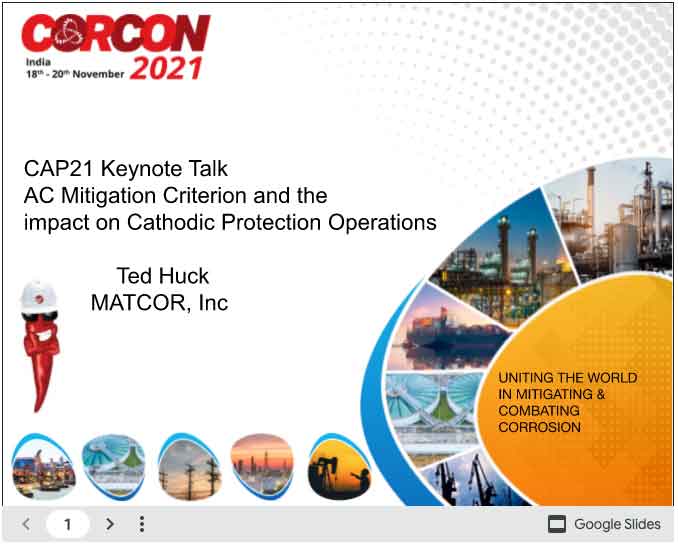
‘MATCOR’s Ted Huck presented a virtual keynote at CORCON 2021. Over 300 corrosion industry professionals connected at the NACE Gateway India Section’s 2021 Virtual CorCon Conference. The primary discussion was around the impact of AC Corrosion Mitigation criteria on the design and operation of cathodic protection systems.

Historically, DC cathodic protection systems are designed to meet specific polarization requirements. The CP system delivers sufficient current to assure that the entire length of the pipeline meets the polarization levels required. Little consideration is given to DC current density, other than to provide a guideline for sizing the CP system.

The actual operation of the CP system is dictated by the amount of current required to polarize the pipeline.

In practice, this often results in operating the CP system by pushing enough current to properly polarize the pipeline to the farthest distance possible from the CP station. Testing is entirely based on these polarization levels. This includes confirmation testing via close interval potential surveys (CIS).

However, the latest NACE specifications on AC Interference and Mitigation (SP 21424-2018) incorporates DC current density as a key parameter. Historically this was not a consideration for the operation of a pipeline’s cathodic protection system.

The AC Mitigation criteria has a stringent requirement if the system’s DC current density is not monitored and controlled. However, if the pipeline’s CP system current density is both monitored and controlled, the requirement is less stringent.

This linking of AC Mitigation Criteria to a DC current density value (that historically has never held any significance) represents a significant change in how CP systems must be designed, monitored, and controlled.


For information about MATCOR AC mitigation solutions, please contact us at the link below, or reach out to your local MATCOR account manager.

Contact a Corrosion Expert

Cathodic Protection Systems | Cathodic Protection Design | alternatives to sacrificial anodes and galvanic anodes