
All posts by MATCOR

Tank Cathodic Protection Trends | Above Ground Storage Tanks

This presentation explores current tank cathodic protection trends, specifically for above ground storage tanks.


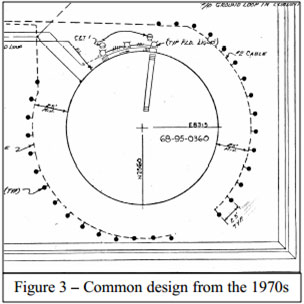
Statistics show owners of above ground tanks often experience external corrosion issues because of limited or poor installation methods. Typical above ground storage tank (AST) methods of the past involve a ring wall foundation that is generally formed with a sand or soil base, or even concrete for smaller tanks. It has previously been acceptable to use a galvanic ribbon anode system (generally magnesium), but this system often fails prematurely due to unstable sand-based foundations and poor connections. For this reason, the industry is moving away from the galvanic anode system and to newer concentric ring tank cathodic protection systems for above ground storage tanks.

Good Engineering Practices

While there are newer designs for AST cathodic protection systems, your first consideration should always be good engineering practices. The proper installation of a high-end tank cathodic protection system begins with known design specifications based on the tank size and diameter. This presentation compares traditional grid anode systems with newer linear anode concentric ring systems for the cathodic protection of above ground storage tank bottoms. In addition, congested terminal environments often lead to interference and less current at the tank bottom.

Grid Anode vs. Concentric Ring Tank Cathodic Protection Systems

tank cathodic protection
Tank Cathodic Protection using MATCOR Tank Ring Anode System for Above-Ground Storage Tanks (ASTs)

While the field-fabricated and field installed grid anode system has been in use for over 20 years, some faults have been discovered. Field installation presents welding challenges for the contractor because the system must first be secured, and it cannot be installed directly over sheet liner. The ribbon anode and titanium conductor bars have to be field cut to the appropriate lengths. At the conductor bar to anode ribbon intersections, a weld is applied. The field assembled grid system is subject to weld failures, the spot welds can be damaged easily during subsequent sand installation, and care must be taken to hold the system in place so that it does not short to the tank bottom. All of these installation challenges can adversely impact the system performance. Additionally, bare MMO in sand is an oxygen generator when used for cathodic protection. Oxygen is a depolarizer and in some instances this can lead to issues with maintaining polarization criteria.

Advantages of the Concentric Ring System

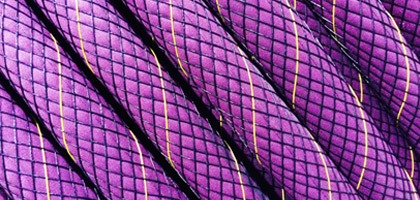
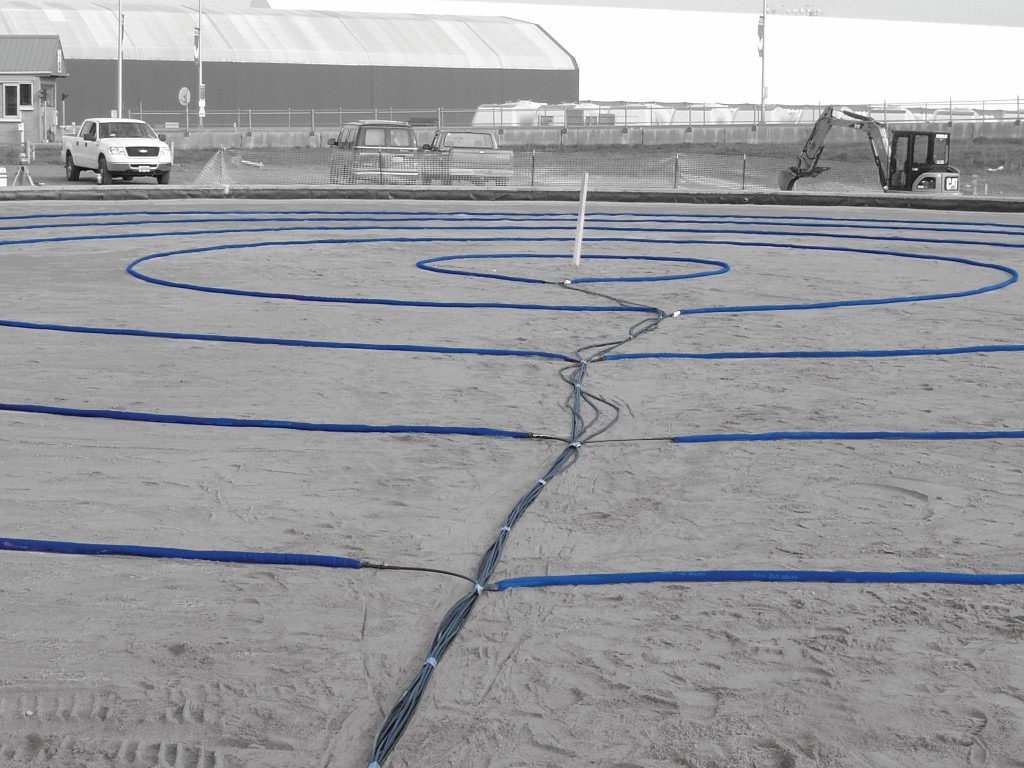
tank cathodic protection designerIn comparison, newer concentric ring systems for above ground storage tanks include factory assembled anode rings that come equipped with the appropriate cable leads to extend past the ring wall penetration. No onsite field assembly is required. The system is pre-assembled in concentric ring sizes designed for your tank and requires no cutting, splicing, or welding, and the MMO wire is backfilled within a braided fabric sleeve with coke breeze. Anode locations are simply marked, each ring is laid out at the proper diameter, and cabling is extended toward the ring wall. The anode cables are labeled for ease of identification and to allow for monitoring of current to each anode ring. Unlike the grid system, the MMO anode is centered in a coke backfill – this coke environment inhibits the generation of oxygen eliminating the issues with depolarization.

The concentric ring tank cathodic protection system is designed for longevity. A typical under-tank ring system using MMO anodes exceeds a 30-year life, however can be designed to extend life beyond 100 years.

Additional Considerations for Tank CP

  • Some tank operators opt for a “replaceable” anode system, however time and manpower are required to extract and replace the anodes and backfill and the design life is only 30 years.
  • Volatile corrosion inhibitors (VCI) are often used in conjunction with cathodic protection systems where CP cannot be installed or may be ineffective, such as ring wall crevices, poor bottom-to-sand contact, and more. It can be pumped under tanks via shielding high-density polyethylene (HDPE) containment liners.

Today, tank owners have more effective choices than traditional grid anode systems for tank cathodic protection. The MATCOR Tank Ring Anode™ System is trending as a high-end solution for above ground storage (AST) tanks.

For assistance with tank cathodic protection design, MATCOR’s Tank Ring Anode System, project management or installation, please CONTACT US.


Learn more about AST Cathodic Protection


Sled Anode Cable Connections

What is the best way to prevent damage to sled anode cable connections due to rough sea current and waves?

MATCOR marine sled anodes (Sea-Bottom™ Anodes) are designed with the cable connections routed inside a high density polyethylene (HDPE) protective pipe with holes to provide a level of mechanical protection. Then we use concrete weights to help secure the HDPE pipe (with the cable inside) to the sea bottom so that they are not subject to wave or tidal action.

Sled Anode Cable ProtectionThe protective housing is pictured here and called out as item 4 on the drawing on page 3 of our Sea-Bottom Marine Anode Sled brochure. For the concrete weights, you can use a variety of methods from sacks of concrete to custom formed concrete cast weights. Below is a photo of the weights that were locally supplied to us for a recent project in Indonesia. These weights are installed by divers during the sled anode installation.

sled anode concrete weights

For assistance with impressed current anode system design, MATCOR’s Sea-Bottom Marine Anode Sleds, project management or installation, please contact us at the link below.

Contact a Corrosion Expert

April 24 is Corrosion Awareness Day

Did you know that corrosion costs us an astounding 2.5 trillion dollars globally?

Not to mention corrosion can cost lives and jobs…

Today is corrosion awareness day, so we thought it would be a good idea to reiterate the importance of the NACE IMPACT (International Measures of Prevention, Application, and Economics of Corrosion Technologies) study released in 2016.

According to the study, most corrosion failures, and nearly all catastrophic corrosion failures are preventable. And nearly $875 billion can be saved through the right prevention and risk analysis efforts.

Through the IMPACT study, NACE determined that in order to reduce the astronomical cost of corrosion, we would have to change how decisions are made regarding corrosion. We must not only continue to develop corrosion control methods and technology, but we must utilize organizational management systems and risk tools throughout all levels of an organization to achieve the greatest success in saving lives, jobs and money.

You can learn more by visiting impact.nace.org.

Tank CP Installation – A Drone’s View!

Easy to Install Tank CP System – No Cutting, No Splicing, No Welding

Tank CP InstallationWe’re excited to share this aerial drone view of a recent tank CP installation starring MATCOR’s exclusive Tank Ring Anode™ System. Superior to grid anode systems for tank bottom cathodic protection, the Tank Ring Anode System is factory assembled in concentric rings sized for your tank and shipped ready for quick installation.

  • Impressed current anode
  • New and retrofit tanks
  • Ready to install
  • No field assembly required
  • Superior current distribution
  • USA manufactured

Learn about MATCOR’s complete cathodic protection installation services.

Concentric ring anode configuration ideal for tank bottom cathodic protection

Learn more about this newer method of cathodic protection for tanks and its benefits over the more traditional grid anode system—read the full article at HERE.

MATCOR tank app

For assistance with impressed current anode system design for tank bottoms, project management, installation or field service, please contact us at the link below.

Contact a Corrosion Expert

MATCOR’s Giving Trees

giving-treeDuring the holiday season, our thoughts turn gratefully to those who have made our success possible. It is in this spirit that the entire MATCOR team says thank you and best wishes for the holidays and New Year.

Our thoughts and well wishes also extend to local families in need.

Our team in Chalfont, PA donated and delivered dozens of wrapped gifts to the Bucks County Housing Group.  The mission of the Bucks County Housing Group is to advance the interests of people with low-moderate income and people in crisis through the provision of affordable housing and related social services. Learn more at bchg.org.

YMCA Angel TreeThe MATCOR team in Guthrie, OK also came together to make one family’s holiday season much brighter. They adopted a family with five children, purchasing fleece coats and outfits for each child along with two items from their gift list. The family was adopted through the Edmond, OK Rankin YMCA Angel Tree. The YMCA strengthens communities through programs that build healthy spirit, mind and body for all.

Happy Holidays and New Year to all!

Impressed Current Anode Systems for Jetty Piling

One of the key decisions for any cathodic protection system design is the choice between an impressed current anode system or a galvanic (or sacrificial) anode system. This is especially true for marine applications where cathodic protection is commonly applied to structures such as steel piling systems on jetties and piers for corrosion protection. A recent MATCOR project highlights the choice between ICCP and Galvanic systems on a newly constructed jetty in Surabaya, Indonesia.

Impressed Current Anode Systems vs Galvanic Anode Systems

impressed current anode systems for jetty piling
Click on the image above to read the full case study comparing impressed current cathodic protection utilizing marine anode sleds with a galvanic anode system.

This case study article, which appeared in the October issue of Materials Performance includes a comparison of key factors for commonly used galvanic (aluminum) anodes and impressed current (titanium with mixed metal oxide) anodes. The key differences between an impressed current anode system and a galvanic anode systems include:

  • Anode consumption rates
  • Current density (CD) limits
  • Driving voltage
  • Anode quantities
  • Installation time and costs

The article describes these key differences in more detail.

Conceptual Design – Galvanic vs Impressed Current

Jetty applications can be designed using either galvanic anodes or impressed current anodes, and often it is a matter of client or designer preference. For this project in Indonesia, the cathodic protection designer reviewed both system types to determine the ideal design for this application based on a 30-year anode life. The final decision was based on several factors including total number of anodes and installation time required, in addition to safety considerations.

Impressed Current Anode System Installation and Commissioning

The final design called for the installation of six marine anode sleds, which took less than a week to complete.

For more details about this impressed current anode system solution for jetty piling cathodic protection, please read the full article in the October issue of Materials Performance. You can also access the full article HERE.

For assistance with impressed current anode system design, MATCOR’s Sea-Bottom Marine Anode Sleds, project management or installation, please contact us at the link below.

Contact a Corrosion Expert

MATCOR Receives Patent for SPL-SandAnode™

Cathodic Protection Anode Designed Specifically for Tank Bottom Replacement Applications

MATCOR was recently issued US Patent No. 9,410,253 for its SPL-SandAnode, an impressed current linear anode that prevents corrosion of above ground storage tank bottoms (ASTs). Invented by Glenn Shreffler, executive vice president of engineering for MATCOR, the SPL-SandAnode is the only impressed current linear anode designed specifically for tank bottom replacement projects. These applications typically have six inches (150 mm) or less of sand where the anode is to be installed.

tank bottom replacement cathodic protection anode
MATCOR’s SandAnode is the only impressed current linear anode designed specifically for tank bottom replacement projects.

The recommended cathodic protection system for most ASTs is a tank ring anode system that utilizes linear anodes in a concentric ring configuration. However, when the clearance between the tank bottom and anode is less than 6-inches (150 mm), the SPL-SandAnode is used, either in the concentric ring configuration or in parallel linear lengths. The prepackaged linear anode with a sand backfill, in lieu of calcined coke, allows the anode to be simply laid out on the foundation while easily maintaining the maximum separation distance of the anode to the tank bottom.

The SPL-SandAnode is one of MATCOR’s SPL™ Anode Series, a complete line of flexible impressed current linear anodes utilizing MMO anode technology to support a broad range of cathodic protection applications. Advantages of MATCOR’s linear anodes include:

  • Single package design
  • Uniform current distribution
  • Flexible cathodic protection system
  • Waterproof Kynex® anode to cable connections

Learn more:  SPL-SandAnode

About MATCOR

Pipeline Rehabilitation and “Attenuation Deficit Disorder”

Around the world, the pipeline industry is seeing a growing number of “attenuation deficit disorder” outbreaks along their older pipelines. This is not a disease or a medical condition afflicting pipeline company personnel, but is a reference to a growing global problem with pipeline cathodic protection (CP) systems that are affected by older coatings that are failing. Pipeline operators need a solution for pipeline rehabilitation.

Pipeline Rehabilitation Solutions

Pipeline Rehabilitation ArticlePipeline operators worldwide are grappling with what to do as their 1950’s, once state of the art coatings systems start to fail. In our recent article in World Pipelines, Ted Huck examines two possible solutions for pipeline rehabilitation:

  • Recoating the Pipeline: At some point in the process of adding more CP stations and increasing the current output to levels that further degrades the coating, it becomes apparent to the pipeline operator that more drastic measures are required.
  • Rehabilitating the Cathodic Protection System: Under the right circumstances, an attractive alternative to the recoat approach is to consider the use of linear anodes as a rehabilitation strategy.

For additional information about these pipeline rehabilitation solutions, please read the full article in the September issue of World Pipelines. You can access the article HERE.

For assistance with cathodic protection design, MATCOR’s linear anodes for pipeline cathodic protection, project management or installation, please contact us at the link below.

Contact a Corrosion Expert

Dean Lioliou Joins MATCOR

MATCOR Houston, Dean LioliouWe are pleased to welcome Dean Lioliou to the MATCOR Team as the Gulf Coast Region Account Manager.

Dean was most recently over sales for ALS Oil & Gas’ Pipeline & Asset Integrity division. His focus was on fiber optic pipeline leak detection, cathodic protection monitoring, corrosion under insulation analysis through thermal imaging technology, and pipeline leak surveying utilizing drone technology. Prior to ALS, he spent many years at Abriox as the Southern Area Regional Sales Manager focusing on Cathodic Protection monitoring.

Dean is very involved with NACE, currently serving as Vice Chairman of the TX/LA Section, a member of the exhibits and conferences committee for NACE International, and is involved in the Houston, San Antonio, and Corpus Christi sections. He is also NACE CP Level 2 certified.

Please join us in congratulating Dean and welcoming him to the organization. He can be reached at 832-755-2714 or by email at dlioliou@matcor.com.

Corrosion Industry Safety and “Captain Obvious”

by Rebecca Haring
Corrosion Industry Safety and Captain ObviousMATCOR Safety & Compliance Manager


Quickly, off the top of your head – what’s the most important factor in your daily corrosion industry safety work life?

It’s Y-O-U and Captain Obvious—what a Dynamic Duo!

Safety managers train you. Regional managers establish procedures and rules. Clients require certain clothing. Your supervisor warns you. But the bottom line is: No program, sign or protective equipment will work if YOU elect not to make safety an intentional part of your daily work life.

“But,” you say, “We’re told the job must be done faster and cheaper.” Be sure you include “The job must be completed without a safety event.”

Make no mistake, every job must finish safely. As soon as it doesn’t, safety becomes the MOST IMPORTANT measure of the job; and you become the yardstick.

Let’s review some simple ways for you to practice safety at every job every day.

Enter Captain Obvious to remind you of corrosion industry safety basics:


Check your work area frequently.

Look around and listen up! Use your senses to prevent a safety event (and you already do it all day every day). What do you see, hear or smell in your work area? Mobile equipment in use? Materials being moved? Walking area slippery? Cords or ropes in your path? Trash not discarded correctly? Machine making a ‘funny’ noise? Do you smell hydraulic fluid?

Observe how your work area changes during the day. Let those working around you know about the changes. Take an active role in making your job site safer by helping to make others aware of the little changes. Sure, you might sound like Captain Obvious. So what? When it helps everyone go home at the end of the day with nothing but a fatter wallet… then THAT’S a good day!

All MATCOR employees abide by our Stop Work Obligation. Every employee at our job sites has an obligation to intervene and stop work when a situation gets identified that could break one of MATCOR’s Life Saving Rules or cause injury or illness.

Electricity and equipment. Both start with “E” and both kill.

Here’s another one from Captain Obvious. Check your electrical equipment every time you use it. Drills, grinders, reeling machines and irons. If it has to be plugged in or charged, there’s the potential for a cracked case, frayed or cut cords or a short somewhere. Make a quick inspection for wear and tear, and intact strain relief and connections.

For larger equipment, like Pipeline Current Mappers, generators or interrupters, take the time to read the Operator’s/Owner’s Manual at least once before you running the machine. If the manual isn’t available, ask someone who has used the machine for a quick rundown.

Wide open and burning hot.

Many times when we hear about a workplace fatality, it involves some kind of fall…in a hole, from heights, or something falling on a worker. Considering the kind of work we do, every worker needs to be aware of 1) what he or she might fall over/into; and 2) what might fall onto him or her. Falls aren’t always fatal, but often workplace fatalities involve falls. Here comes Captain Obvious, again. Be aware and make others aware of anything that might make you fall; or that might fall on you.

Another situation that could burn us on a job site is fire (sorry for the bad pun there). Anywhere there’s machinery, combustible chemicals, or cad welding, the possibility of fire exists. Open flame, especially on a pipeline right-of-way could turn an ordinary day into a hot time that no one wants. Knowing what to do in the event of a fire at EVERY job site makes sense. Where’s the extinguisher? Do you know how to use it? What about the escape route from the site? Yes, you and your crew should create and review the emergency plan at each job site. After all, knowing the best direction to run IS an emergency action plan.

Where IS that first aid box?

Calling Captain Obvious… Do you know where the first aid kit is in your work area? Can you get to it quickly and easily? When was the last time you checked to see if it needed to be restocked? Though you may think that’s someone else’s job, it will matter most to you when you need to remove a splinter, bandage up a cut or treat a burn. Remember, we’re talking about how Y-O-U have the most important part of job site safety. If the first aid kit isn’t ready and available when you need it, the problem isn’t someone else’s. Check the first aid kit.

Corrosion Industry Safety: The last line of defense.

If we can’t engineer a hazard away, we write a procedure to protect you from it. When engineering or administration doesn’t quite eliminate a hazard, you get personal protective equipment (PPE). Here’s the rub. If you choose not to wear PPE, it doesn’t protect you (OMG, Captain Obvious snuck right in there). Hard hats, safety glasses, gloves, or earplugs might be uncomfortable. Then again, so are skull fractures, blindness, amputations and deafness.

PPE may be a last line of defense when it comes to corrosion industry safety, but that makes it no less important. Make sure you don it every time on every job…and speak up if your co-workers need to be reminded.

Wrap it up.

Workers need to take care at all times and at all job sites. No matter how many machines have guards, or safety policies the company writes, Y-O-U have the biggest impact on your safety. Awareness of your work space, inspecting your tools, knowing how to get out in an emergency or where to find the first aid kit are all factors in YOUR control.

You make decisions every day that impact how, or if, you and your crew go home. Will it be with a fatter wallet? Or will it be with stitches, or in a cast or worse? Captain Obvious knows.

MATCOR takes corrosion industry safety very seriously and maintains an excellent safety record.

Learn more about MATCOR Safety Programs or contact us for additional information.

Cathodic Protection Systems | Cathodic Protection Design | alternatives to sacrificial anodes and galvanic anodes